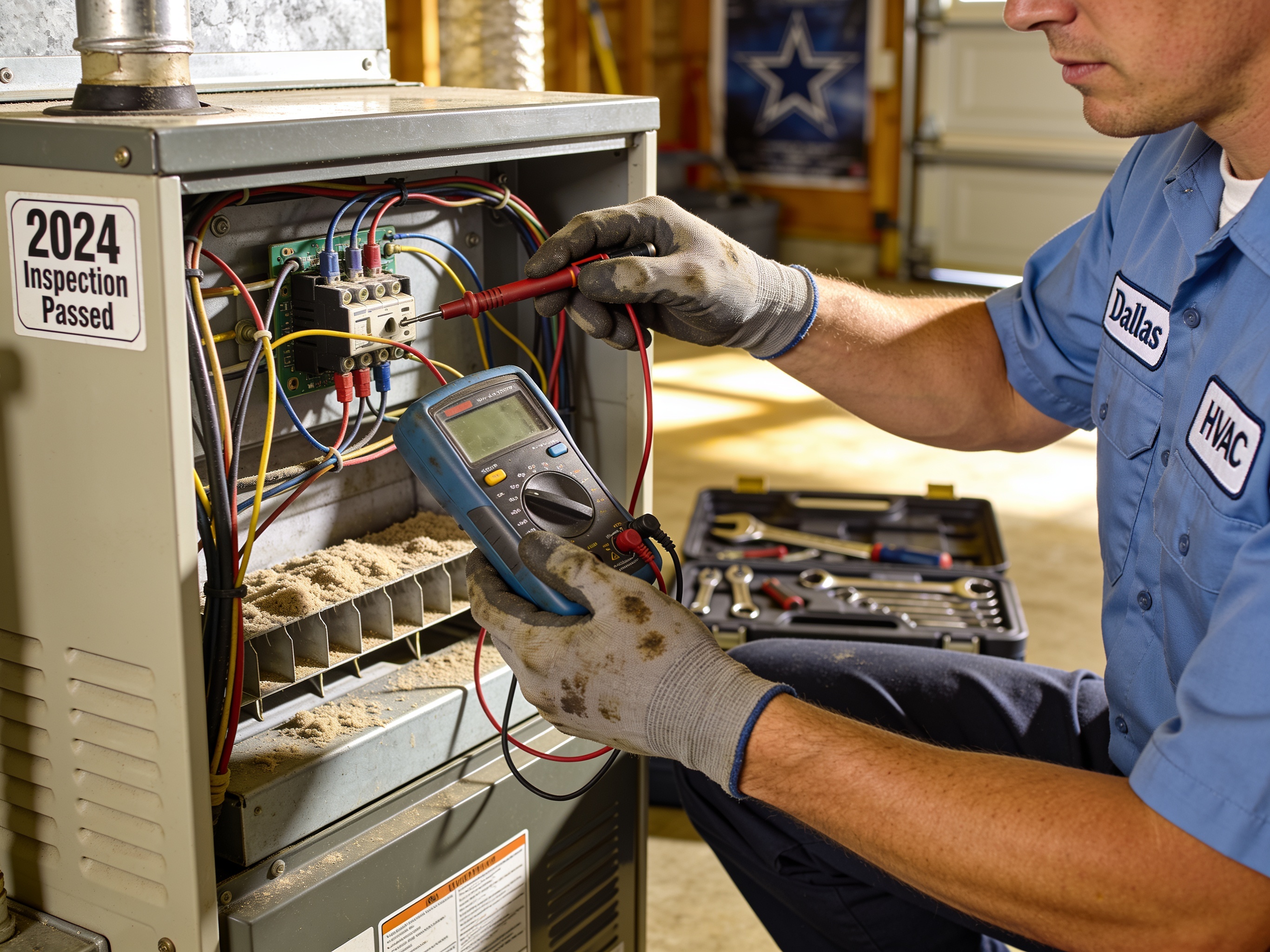
1. What Heating Repair Is
Heating repair is the diagnosis-led restoration of a heating system that no longer produces heat as it should. The system may be a gas or electric furnace, a heat pump operating in heating mode, or electric resistance heat. Each follows the same repair logic. The technician identifies the failed part, confirms the evidence, makes the repair, and checks that the system starts, runs and shuts off the way it was designed to.
In practice, diagnosis-first means the fault is proven before any part is condemned. A component is replaced only after the evidence shows it has failed, not because it is old or because a symptom suggests it. The diagnosis is written down before any part is ordered. Furnace depth, heat pump depth and replacement each live on their own pages, so this page covers the repair work itself.
Dallas gives heating repair its particular shape. Summers here are long and severe, so the air conditioner does most of the work for most of the year. The heating system sits idle through the warm months, then meets a winter that can turn hard. According to NOAA climate normals for Dallas Love Field, hard freezes are a normal part of the local winter. A system that has been quiet for months is asked to run hard on the coldest nights, which is when its faults usually show.
That pattern explains why heating calls cluster on the coldest nights. Faults that were present all autumn often stay hidden until the first sustained cold snap.
Call American HVAC Pros to describe what the heat is doing, and the first conversation will sort out which type of heat you have and which symptoms you are seeing. A clear description at the start shortens the diagnosis that follows.
Questions about furnace lifecycle, including burner and heat exchanger depth, belong on our Furnace Services page. Heat pump service is covered on Heat Pump Services, and a system being replaced is covered on Heating Installation. This page owns heating repair in general.
2. When You Need It
Heating repair is needed when the system is not producing heat as it should. The usual signs are no heat, short cycling, cold air from the vents while the system runs, and a furnace that lights and then drops out. If any of these appear, arrange a visit rather than waiting for the system to fail completely.
You need heating repair when the system is not doing its job. Common signs include:
- No heat at all, or heat that never reaches the thermostat setpoint.
- The system starting and stopping in short cycles.
- Cold air coming from the supply vents while the system is running.
- Unusual smells or sounds at the first firing of the season, after months of rest.
- A furnace that lights, runs briefly, then drops out.
Each symptom points to a different part of the chain. Short cycling or a furnace that drops out often signals a safety response, while no heat at all can point to ignition or power. The system is idle through the cooling season, so faults can sit hidden until the first cold nights reveal them.
Some situations call for immediate action rather than a scheduled visit. If you smell gas, leave the building, keep the doors open behind you, and call your gas utility's emergency line from outside. If a carbon monoxide alarm goes off, leave the home first and call for help from outside. Do not stay inside to investigate, and do not try to find the source yourself. These steps are simple prudence, and they apply whether the heating system is old or new.
The first cold night of the season is effectively a shakedown run. Across the metro, many systems are switched on for the first time in months, often on the same evening. Faults that were minor in October can become no-heat calls in January. Treating the first cold spell as a check-in, rather than waiting for a breakdown, gives you time to act while the weather is still manageable.
Once the system is safe, call American HVAC Pros to arrange the visit. The sooner a fault is described, the sooner the technician can start the triage that sorts a simple fix from a larger problem. Local service details for Dallas are on the Dallas service area page.
3. How the Work Runs
Heating repair runs in six steps: call and triage, diagnosis, findings stated plainly, repair, verification, and the honest fork. No repair is authorised until the failed component and the evidence have been explained to you.
Heating repair follows a set sequence. Each step builds on the one before it.
1) Call and triage
The first step is a conversation about the heat type (gas furnace, heat pump, or electric heat), the symptoms, and any safety signs. Smells, alarms, scorching or smoke are screened before anything else. If a safety concern appears, the work stops there and the safety response comes first. Triage establishes the heat type, the symptoms and the safety picture before anyone travels, so the visit is planned around what is actually happening.
2) Diagnosis
The technician checks the system in the order it starts up: controls and power first, then the ignition sequence, then airflow, then the heating-specific components. Following the startup order keeps the diagnosis systematic. Each check either clears a component or narrows the search.
3) Findings stated plainly
Before any repair is authorised, the technician explains the failed component, the evidence that proves the failure, and the repair that is proposed. You decide how to proceed with a clear picture of what the system needs.
4) Repair
The failed component is repaired or replaced. Safety controls, including limit switches, flame sensing and pressure switches, are tested as part of the repair. They are never bypassed. A safety control that is stopping the system is doing its job, and the reason behind it is what needs fixing. Before any restart is attempted, the safety state is checked, so a tripped control is understood rather than simply reset.
5) Verification
The technician runs a full heating cycle, measures the temperature rise across the system, and confirms that the system shuts off correctly once it reaches setpoint. A repair is complete when the system runs through the whole cycle safely, not just when it lights once. The check covers a full heating cycle watched end to end, from ignition through the blower run to shutdown at setpoint. The visit does not close until the system has been watched through that full heating cycle at least once.
6) The honest fork
Sometimes the diagnosis shows that the heat exchanger has failed, or that the system is near the end of its service life. In those cases the findings are routed to Heating Installation or Furnace Services, with the reasoning stated clearly. Safety findings are never softened to keep a repair alive.
4. What's Inside This Service
Four areas make up most of what this service addresses: ignition and flame, airflow, controls and safeties, and heat pump heating faults. Each block below gives the symptoms, how the fault is proven, and the factors that shape the cost of the fix.
Heating repair covers four areas. Each one produces recognisable symptoms and has a clear way of being proven.
Ignition and Flame
The igniter, flame sensor and gas valve form the chain that lights the burners and keeps them lit. A worn igniter can fail to light, a dirty flame sensor can let the flame drop out after a minute, and a gas valve that does not open can produce no heat at all. This is why most no-heat calls begin here. Each component is proven by watching the ignition sequence through its steps, checking the sensor reading during operation, and confirming the valve opens and holds under command. A repair in this area is only complete when the flame holds through the full cycle. The cost here depends on whether the igniter, sensor or valve is implicated, and on how easily the burner area can be reached. The technician also confirms the ignition sequence completes in order before the panel is closed.
Airflow in Heating Mode
The blower and the air filter move heated air through the house. A clogged filter, a failing blower motor or a restricted duct can cause the system to overheat. When it overheats, the limit switch opens and shuts the burners down. The homeowner sees a furnace that lights, runs, and quits, and it looks like a furnace failure. In fact the furnace is reacting to poor airflow. Proving this means measuring temperature rise and checking the blower's operation under load. Once airflow is restored, the limit switch stops tripping. The cost depends on whether the fault is a filter, a blower component or a duct restriction, and whether the blower motor is still available for the model. The technician also checks the filter and blower condition before deciding airflow has been restored.
Controls and Safeties
The thermostat, control board, limit switch and pressure switch form the chain that decides whether a furnace may run at all. A thermostat that sends the wrong signal can call for heat the system cannot deliver. A failed board can misread a safety input. A pressure switch that does not confirm proper venting will hold the burners off. Each element is tested in sequence, so the technician can see which link in the chain is breaking. Repairs in this area restore correct signals, and they never remove a safety input to get the system running. Cost here depends on which control or safety device is implicated, whether a board or switch must be replaced, and how accessible the control panel is. The technician confirms the thermostat signal and the pressure switch reading before the system is returned to service.
Heat Pump Heating Faults
In a heat pump, heating faults often look like a furnace problem. A reversing valve that sticks can leave the system unable to switch into heating mode. Auxiliary (backup) heat may run once the heat pump has fallen back, raising energy use and making the system seem to be failing. At triage, the technician checks whether the heat pump is actually heating, whether auxiliary heat has engaged, and whether the reversing valve switches correctly. The deeper diagnosis of heat pump components is covered on Heat Pump Services. The cost depends on whether the reversing valve or a control is implicated, and whether the part is still available for the model. The technician confirms the system switches cleanly between heating and cooling before closing out.
Every block carries the same cost logic. The cost of a fix depends on which component has failed, how hard it is to reach, whether a safety device is implicated, and whether the part is still available for the model. These are factors, not figures. The technician will explain them in the findings before any work begins.
5. Heating Repair and the Texas Framework
Heating repair sits inside the Texas licensing framework for air conditioning and refrigeration contractors. Licensing governs who may perform the work, while permitting governs when a City permit is needed. The sections below set out both and show what you can verify yourself before work begins.
Heating and cooling work in Texas is regulated by the Texas Department of Licensing and Regulation (TDLR). Under Texas Occupations Code Chapter 1302 (rules at 16 TAC Chapter 75), air conditioning and refrigeration (ACR) contractors must be licensed by TDLR, and offering ACR services in Texas requires that licence. A company must also employ an ACR contractor at each permanent location. Technicians must be TDLR-registered or certified and supervised.
These rules give homeowners a verification right. Before any work begins, you can check any company's licence on the [TDLR licence lookup](https://www.tdlr.texas.gov/LicenseSearch/). Ask for the licence details, and check them yourself. The lookup lets a homeowner confirm that a company's licence is current and that its name matches the contract, before authorising any work.
Permits are a separate matter. In Dallas, a mechanical (HVAC) permit is required when a heating or cooling system is installed, replaced or modified, and the permit is pulled by a City-registered ACR contractor through DallasNow. Repair that turns into replacement enters this permit framework. Ordinary repair by a licensed contractor generally needs no City permit, while replacement does, which is why the scope of the job matters. Suburbs around Dallas run their own permitting where it applies, so the rules depend on the address and the city that governs it. The detail lives on the Heating Installation page and on the Dallas page.
This page describes the licensing framework only. American HVAC Pros's own licence status is not stated here, and you should verify it through the TDLR search before you hire us.
6. What Heating Repair Costs Depend On
The cost of heating repair depends on the failed component, the age and parts availability of the system, access to the equipment, the safety components involved, and the repair-versus-replace horizon, and the findings explain how each one applies to your system.
No single price applies to heating repair. The cost of a fix depends on the factors below, and the findings explain how each one applies to your system.
- The failed component. An igniter, a sensor, a board and a blower motor each carry a different repair path and a different level of labour.
- System age and parts availability. Older models may need parts that are harder to source, and that changes the repair and its timing.
- Access. A furnace in a tight attic or crawlspace takes more time to reach and work on than one in an open utility space.
- Safety components. When a limit switch, flame sensor or pressure switch is implicated, the repair includes proving that device works properly.
- The repair-versus-replace horizon. A repair on an aging system may buy time, or it may not. The honest comparison is part of the findings.
Every repair starts with findings before authorisation. The technician explains the failed component, the evidence and the proposed repair, and you decide whether to proceed. Heating repair is a diagnosis-first service, and no repair begins without your agreement. Nothing is authorised on the basis of a guess, and the reasoning is set out plainly before any work starts, so you can weigh the options with clear facts.
7. Questions People Ask
Why does the furnace always seem to fail on the coldest night?
The system sits idle for months while the air conditioner carries the load. When winter arrives, the heating system must run hard after its long rest, often on the coldest nights of the year. Faults that were present all season, such as a weak igniter or a slipping thermostat signal, tend to show themselves under that load. The first sustained cold snap acts as a shakedown run for the whole system. Regular checks before winter reduce the chance of a no-heat call on the coldest night. For local detail, see the Dallas service area page.
My furnace starts, then shuts off after a minute. What causes that?
This pattern usually involves flame sensing or the limit switch. A dirty or failing flame sensor can let the flame drop out shortly after ignition, which shuts the gas valve off as a safety measure. A limit switch can also open if the system overheats because of restricted airflow. Both are safety responses, not random faults. The technician checks the flame sensor reading during operation and measures airflow and temperature rise to find which safety is responding and why.
Is it safe to keep resetting a furnace that keeps stopping?
No. A furnace that keeps shutting down is being stopped by a safety control for a reason. Repeated resets can hide a problem that is getting worse, and they can expose you to risks such as gas or combustion faults that should be investigated. If the system keeps stopping, turn the thermostat down, leave the system off, and call for service. If you smell gas or a carbon monoxide alarm sounds, leave the home first and call from outside.
What should I check before calling for heating repair?
Start with checks that carry no risk. Confirm the thermostat is set to heat and that the setpoint is above the room temperature. Check the air filter and replace it if it is clogged. Look at the breaker panel to see whether the heating circuit has tripped, and reset it once if it has. If the system still fails, or you smell gas or notice scorching, stop and call. Do not open panels or adjust gas components yourself.
Call American HVAC Pros to describe what you have checked.