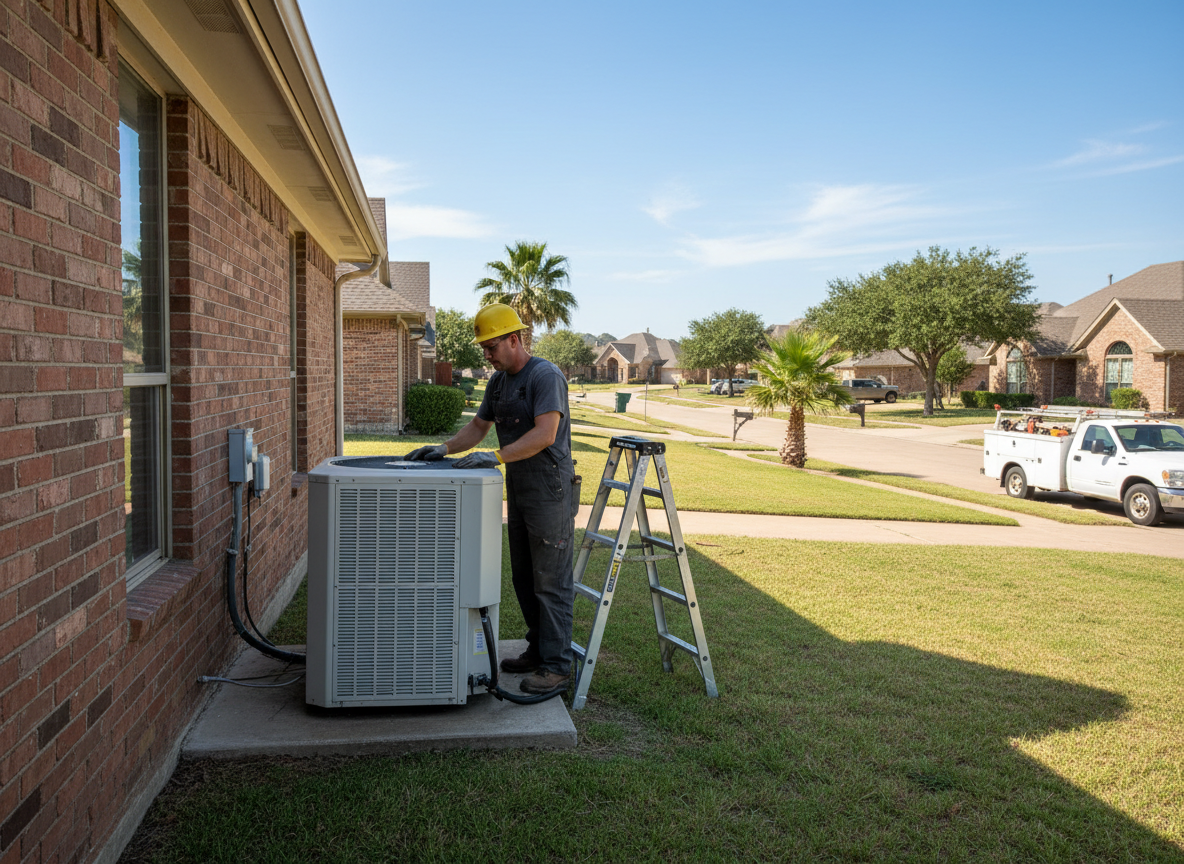
1. HVAC in University Park
If your air conditioner has stopped cooling, or one room never seems to reach the set temperature, American HVAC Pros can help with AC repair in University Park, TX. Call American HVAC Pros to describe what the system is doing, and we will talk through the next step from our Dallas base at 2249 Vagas St, Dallas, TX 75219. Heating help is available too, for cold snaps.
University Park is an enclave city of 25,323 people, set entirely inside the City of Dallas. Census figures put its density at 6,857.8 people per square mile, the densest community in our service area. It is also the most family-weighted. 28.9 percent of residents are under 18, and the average household holds 3.12 people. With that many people per household, every room is in use, and several people rely on the same system at once.
That shapes what comfort means on a University Park street. In a full house, a fault in one room is felt across the whole household, because every room is in use and the system serves all of them. A comfort failure of that kind is a whole-home problem, not a single-room one. Heating matters just as much, because the metro has real winter cold as well as a long summer.
We write about University Park with the wider Dallas area in mind, because the same climate, the same state licensing rules and similar home types shape most of the decisions here. This page explains how we approach those decisions, what the work involves, and how city and state rules apply, so you can choose your next step with the facts in front of you.
2. University Park's HVAC Demands
Dallas sets the climate, and University Park lives inside it. NOAA 1991 to 2020 normals for Dallas Love Field show a long, severe cooling season and hard winter freezes as a normal feature. Heating and cooling both carry real load here, and a system that handles one season well can still struggle in the other.
In a full house, the cooling load is a whole-house load for most of the year, as the NOAA pattern for Dallas suggests. Evenness across rooms matters because every room is in use.
For a large household in a dense neighbourhood, the hardest part is often evenness. When three or four people are home at once, every room asks the system for air at the same time. A bedroom at the far end of the hall, a home office over a garage, and a living room with afternoon sun all need to reach the set temperature. When one room lags behind, someone in the house notices within the hour.
Rooms that must all work at once depend on the whole system, including the ductwork and controls, to deliver even heating and cooling.
Indoor air quality also matters to comfort in a full house. Filtration, humidity control and ventilation change how a house feels and how the system runs day to day, so we treat indoor air quality as a comfort mechanism only. We make no health claims for any of them.
A busy house is a demanding one for any system, which is why the right question is rarely about a single component. The useful question is how the whole system, including the ductwork and the controls, performs for everyone in the home at the same time.
3. What American HVAC Pros Does in University Park
American HVAC Pros is a Dallas HVAC company based at 2249 Vagas St, Dallas, TX 75219. We serve University Park homeowners from that base.
- AC Repair for a system that has stopped cooling, runs poorly, or has started making new sounds.
- AC Installation when the decision is a new system, and the choice of system type and sizing matters.
- Indoor Air Quality Services for filtration, humidity and ventilation questions that affect everyday comfort.
- AC Maintenance for tune-ups that keep a cooling system ready before the hottest months arrive.
We also handle Heating Repair, Heating Installation, Furnace Services, Heat Pump Services, Ductless Mini-Split Systems and Air Duct Cleaning.
The household picture in University Park shapes how these services are chosen. Census figures show a dense area of 6,857.8 people per square mile, with 3.12 persons per household and 28.9 percent of residents under 18. Full homes like these put steady demand on cooling and heating, so the owner of a family house usually weighs repair, maintenance and replacement against how many rooms depend on the system. Because 83.2 percent of housing is owner-occupied, the owner is the person who decides. We keep each explanation in plain terms, so the decision stays with the owner and the choice of service is made with the facts in front of them.
Each service page explains the decision in plain terms, so you know what the work involves before you agree to it. If you are not sure which service fits your situation, describe the symptom when you call and we will point you to the right page.
4. University Park Local Facts
The Family Profile in University Park
University Park has the largest average household size in our service set. Census figures put it at 3.12 persons per household. 28.9 percent of residents are under 18, the highest share among the communities we serve, while only 8.6 percent are aged 65 or older, the lowest share in the set.
For a property owner, this means most homes here are full. A household of this size usually uses most of its rooms, and comfort problems affect everyone at once. When cooling fails in a house like this, it is a household event, not a minor inconvenience.
In practice, a family home needs repair and maintenance planned around daily use. Keeping cooling reliable before peak summer heat, and dealing with a heating fault before the first hard freeze, are the decisions that matter most to a household like this.
Density and Owner-Occupation
University Park packs 6,857.8 people into each square mile, the densest figure in our service set. Census data also shows 83.2 percent of housing is owner-occupied. Taken together, that means many owners live close to their neighbours and make the decisions about their own homes.
For a property owner, that changes the job. The homeowner usually chooses the contractor, approves the work and lives with the result. Most homes here are owner-occupied, so the owner usually decides on a replacement. When a system is worn, the owner decides whether to repair it, replace it, or improve the ductwork that carries its air.
In practice, that means houses sit close together, and records of work stay with each property.
Dense streets also mean careful, tidy work matters.
An Enclave With Its Own Permitting
University Park is a separate city, even though it sits entirely inside Dallas. The City of Dallas surrounds it on every side, but the two cities run their own permitting, so permitting questions go to University Park. The City of Dallas issues its mechanical permits through DallasNow, and that system does not apply here. The owner confirms the city's requirements for the property directly with the city before any work starts. One part of the framework is the same across Texas and across the county line. Air conditioning and refrigeration contractors are licensed by the Texas Department of Licensing and Regulation (TDLR) under Texas Occupations Code Chapter 1302. That statewide framework is constant across the line, so a homeowner can check any contractor's licence through the TDLR search.
Distance From the Dallas Base
American HVAC Pros is based at 2249 Vagas St, Dallas, TX 75219. From that address, University Park is about 4.7 miles away in a straight line and about 5.9 miles by road. These distances come from MapSof and describe distance only.
For a University Park property owner, the practical point is that the business works from one Dallas address, 2249 Vagas St, Dallas, TX 75219, that sits close to the area. The distance is a fact about where we are, not a promise about how quickly anyone can arrive. The distance describes location only, not timing.
Knowing the distance can help you plan a visit, but it does not set a timeline. Describe the symptom when you call, and we will explain the next step.
5. Permits and Licensing for HVAC Work in University Park
Permits and licensing are two separate questions, and homeowners should ask about both before any HVAC work begins.
Dallas runs its own mechanical-permit process inside the city, while University Park is a separate city.
Licensing is set at state level. The TDLR licenses air conditioning and refrigeration (ACR) contractors under Texas Occupations Code Chapter 1302, with rules in 16 TAC Chapter 75. Offering ACR services in Texas requires a licence. Class A covers units of any size, and Class B covers cooling up to 25 tons and heating up to 1.5 million BTU per hour. A company must employ an ACR contractor in each permanent location, and technicians must be TDLR-registered or certified and supervised.
As a check, a homeowner can use the TDLR search to confirm that the company's licence number matches the business named in the paperwork. The same lookup covers the whole state framework. Then confirm that the company employs an ACR contractor in each permanent location, as Texas requires, before you agree to any work, and ask for that confirmation in writing.
These statewide rules hold across the county line and throughout the metro, so the same framework applies in University Park as elsewhere in Dallas County.
Permits are not licensing, and neither one replaces the other. Before work starts, confirm in writing who is responsible for each permit step and each inspection. Ask us how the permit question applies to your project, and we will tell you what we know and what needs to be checked with the city.
6. Reaching American HVAC Pros From University Park
Our Dallas base is at 2249 Vagas St, Dallas, TX 75219. University Park is about 4.7 miles from that address in a straight line and about 5.9 miles by road.
To get started, call American HVAC Pros to describe what the system is doing, or call to arrange the visit. When you call, note the system type, what it is doing, which rooms are affected and whether you own the home, so we know who can approve the work. Have these details ready when you call:
- The full property address in University Park, including any gate or access instructions.
- What the system is doing, such as no cooling, weak airflow, unusual noise or a heating fault.
- The system type if you know it, such as central air, a furnace, a heat pump or a ductless unit.
- When the problem started and whether anything changed beforehand.
- Any recent service records or permit paperwork you already have for the system.
7. Questions People Ask
Does Dallas's HVAC permit process apply in University Park?
No. University Park is a separate city inside Dallas, and the two cities run their own permitting. The City of Dallas issues its mechanical permits through DallasNow, and that system does not apply in University Park. Permitting questions for a University Park property go to University Park itself, so confirm the city's requirements for your property before any installation or replacement work starts. We do not describe University Park's own process here because it was not sourced for this page.
How can I check an HVAC contractor's Texas licence?
Use the Texas Department of Licensing and Regulation licence search at [TDLR licence lookup](https://www.tdlr.texas.gov/LicenseSearch/). Air conditioning and refrigeration contractors are licensed under Texas Occupations Code Chapter 1302, and TDLR licence numbers for these contractors begin with TACL. Ask any company for its licence number, then search it on the lookup and confirm that the name matches the business you are dealing with. Check this before you agree to any work, and keep a record of the result.
How far is University Park from the business's Dallas base?
American HVAC Pros is based at 2249 Vagas St, Dallas, TX 75219. University Park is about 4.7 miles away in a straight line and about 5.9 miles by road, according to MapSof. Those figures describe location only and do not set a travel time or a timeline for any visit. Use them to understand where the business sits relative to your home, and describe the symptom when you call so we can explain the next step.
What should I have ready when I call about HVAC work in University Park?
Have the property address ready, including any gate or access instructions. Describe the symptom in a sentence or two, such as no cooling, weak airflow, unusual noise or a heating fault. Note the system type if you know it, and the date the problem began. Mention any recent repairs and the thermostat settings you have been using. Have any permit or service paperwork already on file ready to share. Those details help us explain the next step clearly.