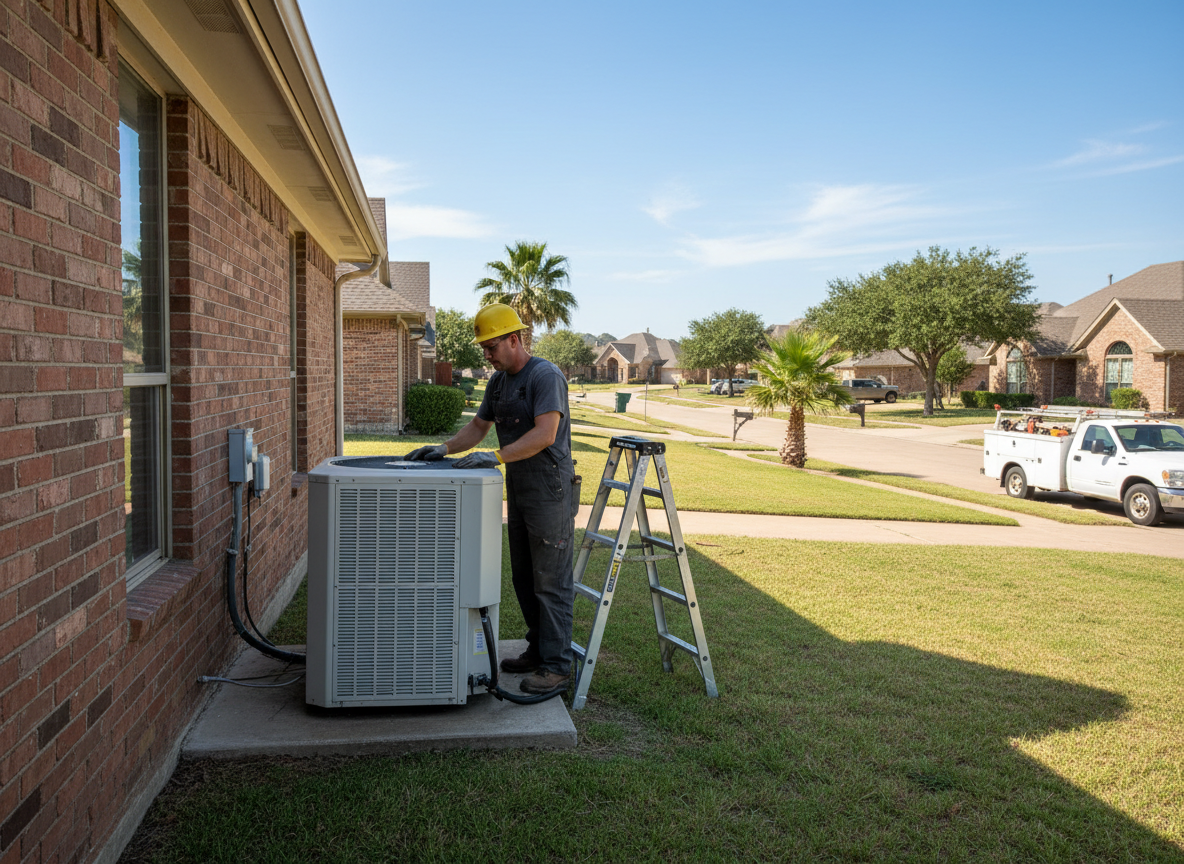
1. HVAC in Dallas
American HVAC Pros provides AC repair and heating and cooling help for homes in Dallas, Texas. When an air conditioner stops cooling or a furnace will not start, call American HVAC Pros to describe what the system is doing and to arrange the next step. The business is based at 2249 Vagas St, Dallas, TX 75219, and Dallas is where this work is carried out.
Dallas is a city of 1,329,491 people, according to the U.S. Census Bureau's July 1, 2025 estimate. Across that population, the HVAC system is the hardest-working appliance in most homes. It runs through the longest cooling months of the year and still has to deliver reliable heat when a winter cold front arrives. Many households depend on it every day, and few owners think about it until it fails.
The HVAC system works through the long cooling season and the winter heating snaps, so a failure matters in every month. Dallas has 533,915 households with an average of 2.42 persons per household, and 11.8% of residents are 65 or older. Owner-occupied housing makes up 42.4% of those households, so most Dallas homes are rented.
This page covers Dallas itself: its climate, the licensing and permit framework that applies to HVAC work here, and how the city's housing shapes who calls for help. The services are summarised in one section and linked to their own pages. Renters and owners both need a clear route to service, and this page sets out how that route works in Dallas, from the first report to the permit and inspection.
2. Dallas's Climate Demands
Dallas has a long, hot cooling season and a winter that is mild on average but still cold enough to test heating equipment. According to NOAA's 1991-2020 climate normals for Dallas Love Field, the mean daily maximum temperature in July is 96.9°F (36.1°C) and in August is 97.1°F (36.2°C). Those are the months when an air conditioner works hardest, day after day.
Winter looks different on paper. The normals put the January mean daily maximum at 57.7°F (14.3°C) and the January mean daily minimum at 37.9°F (3.3°C). An average January can feel mild. Averages hide the cold snaps, though. The January mean minimum is 22.5°F (−5.3°C), and the station's record low is −3°F (−19°C). Freezing nights are a normal part of the winter pattern, not a rare exception.
That combination is why both systems earn their keep. A cooling system that runs for much of the year needs to be sound before the hottest weeks arrive. A heating system that sits idle through most of winter still has to start on the coldest night of the year. Owners who only think about heat in December can be caught out in January.
The NOAA 1991-2020 normals for Dallas Love Field show how the heat carries on after dark. The June mean daily maximum is 92.7°F (33.7°C), and September's is 90.0°F (32.2°C). The July mean daily minimum is 77.7°F (25.4°C), and the August mean daily minimum is 77.4°F (25.2°C). Nights stay hot through the cooling season, so the system is asked to run around the clock rather than only in the afternoon.
The normals also record annual precipitation of 39.33 inches (999 mm), with May and October the wettest months. Wet periods make indoor humidity and condensate drainage worth watching throughout the year.
3. What This Business Does in Dallas
The business is based in Dallas, and the ten services below are the whole of its offer, each set out in full on its own page. Everything in this section applies to the work carried out from the Dallas base, and no other service is listed.
American HVAC Pros covers heating and cooling work from its Dallas base. Each service has its own page with the detail. This section gives a short summary of each.
- AC Repair: diagnosis and repair when an air conditioner stops cooling, runs poorly or shuts off.
- AC Installation: new air conditioning systems for homes in Dallas.
- AC Maintenance: scheduled checks that keep a cooling system running well before peak season.
- Heating Repair: repair of heating equipment that fails to produce heat.
- Heating Installation: new heating systems and the choices that come with them.
- Furnace Services: repair, maintenance and replacement planning for furnaces.
- Heat Pump Services: service for heat pumps, which provide both heating and cooling from one system.
- Ductless Mini-Split Systems: service and installation for ductless heating and cooling systems.
- Indoor Air Quality Services: filtration, humidity and ventilation work to improve the air inside the home.
- Air Duct Cleaning: cleaning of the ductwork that carries conditioned air through the house.
Whether the need is a repair on a summer afternoon or a plan for a replacement, each service page explains what the work involves. This page stays focused on Dallas: the city's climate, its licensing and permit rules, and the homeowners and renters who call for help.
4. Dallas Local Facts
Four facts shape HVAC work in Dallas: the renter majority, the state licence framework, the city permit, and the five-county footprint.
A Renter-Majority City
Owner-occupied housing makes up 42.4% of Dallas's 533,915 households, according to U.S. Census Bureau QuickFacts. That leaves most Dallas households renting, so the person who notices a failing system is often a tenant rather than the owner. In practice, a tenant usually discovers the problem and reports it, while the owner or property manager authorises the visit and keeps the records. For HVAC work in Dallas, this split shapes the whole process. A useful report includes what the system is doing, when it started and whether the problem is getting worse, so the owner or manager can approve the visit quickly. Owners who are out of town or who manage several properties benefit most from a clear written record of each call.
The TDLR Licensing Framework
Texas licenses air conditioning and refrigeration (ACR) contractors through the Texas Department of Licensing and Regulation (TDLR), under Texas Occupations Code Chapter 1302 and the rules in 16 TAC Chapter 75. Offering ACR services in Texas requires that licence. A company must also employ an ACR contractor in each permanent location, and technicians must be TDLR registered or certified and supervised. For a Dallas homeowner, the licence lookup on the TDLR website is the verification tool. Anyone can search it. The check shows whether a company is authorised to offer ACR work in Texas, which is the first question to answer before work starts. This section describes the state framework only. It does not state the licence status of American HVAC Pros.
The Dallas Mechanical Permit
Installing, replacing or modifying an HVAC system in Dallas requires a Mechanical (HVAC) permit from the City of Dallas. The permit is pulled in DallasNow, the City's permitting system, by an Air Conditioning Contractor registered with the City. The City's guide states that the contractor must hold an active TDLR state licence and a current City registration before pulling a mechanical permit. Each trade permits and inspects separately, so HVAC work carries its own permit even when other trades are involved in the same project. For a Dallas property owner, the practical result is that a replacement is a permitted, inspected job, and the permit is part of the work rather than an optional extra. Owners can ask the contractor which permit has been pulled before the work begins.
One City, Five Counties
Dallas is the county seat of Dallas County, and portions of the city extend into Collin, Denton, Kaufman and Rockwall counties. That is why a Dallas address can sit under a different county line from another Dallas address. County lines do not change the state licence framework. TDLR licensing under Chapter 1302 applies across Texas, so the licence rules for an ACR contractor are the same wherever in the city a property sits. What changes is the local detail to check. A homeowner should confirm the contractor's state licence in every case, and should ask the contractor which local permit applies to the specific property before any work starts. County names are a fact of geography, not a reason to expect different licence rules.
5. Permits and Licensing for HVAC Work in Dallas
Replacing an air conditioner or furnace is a larger decision than a repair, and the paperwork is part of it. Before a replacement in Dallas, a homeowner should expect three things.
First, the contractor's licence should be verifiable. Texas requires ACR contractors to be licensed through TDLR, and the public licence lookup lets a homeowner check that status before agreeing to any work.
Second, the permit should be pulled by a registered contractor. Under the City of Dallas guide, a Mechanical (HVAC) permit is required for installing, replacing or modifying an HVAC system. It is pulled in DallasNow by an Air Conditioning Contractor registered with the City. The homeowner does not need to pull the permit personally, but should confirm that it is in place before the work begins.
Third, the work is inspected, and each trade has its own permit and inspections. If electrical or plumbing work is part of the same project, each trade keeps its own permit rather than sharing one.
A homeowner who gets these three checks in writing has a clear record of the licence, the permit and the inspections for the replacement, and can compare each contractor's paperwork on the same basis.
Keep copies of the permit and inspection paperwork with the home's records. They show the work was carried out under the City's process.
This is where the honest boundary matters. Suburbs and neighbouring cities run their own permitting, and the six area pages say so. The permit process described on this page is the City of Dallas process only. A property in another city must be checked against that city's own rules, and this page does not describe them. Homeowners who are not sure which city or county governs their property should confirm that before they plan a replacement.
6. Calling from Dallas
American HVAC Pros is based in Dallas at 2249 Vagas St, Dallas, TX 75219. The business works from that Dallas base, and this page is written for homes in the city.
To reach the team, call American HVAC Pros to describe the problem and arrange the visit. The phone is the contact route for this site, so the call is the place to start.
Before you call, have these details ready:
- The system type: air conditioner, furnace, heat pump, ductless mini-split, or a combination.
- The symptoms: what is happening, when it started, and whether it is getting worse. Note any unusual sounds, smells or thermostat behaviour.
- Whether you own or rent the home: renters should have the owner or property manager's contact details and the lease at hand, since the owner or manager usually authorises the visit.
Having these details ready keeps the call focused and helps the team understand the situation before a visit is arranged.
7. Questions People Ask
Do I need a permit to replace my AC or furnace in Dallas?
Yes. Installing, replacing or modifying an HVAC system in Dallas requires a Mechanical (HVAC) permit from the City of Dallas. The permit is pulled in DallasNow by an Air Conditioning Contractor registered with the City, and each trade needs its own permit and inspections. Ask the contractor to confirm the permit before work begins.
How can I check whether an HVAC contractor is licensed in Texas?
Use the [TDLR licence lookup](https://www.tdlr.texas.gov/LicenseSearch/). Texas licenses air conditioning and refrigeration contractors under Texas Occupations Code Chapter 1302, and offering ACR services in Texas requires a licence. Licence numbers carry endorsements, including E, R and C. Check the status shown in the lookup before any work starts.
Why does Dallas need serious heating if winters are mild?
Because averages hide cold snaps. The NOAA normals for Dallas Love Field give a January mean daily minimum of 37.9°F (3.3°C), which sounds mild. The January mean minimum is lower, at 22.5°F (−5.3°C), and the station's record low is −3°F (−19°C). Hard freezes are a normal part of the Dallas winter, so a heating system must be ready for the coldest nights, not only the average ones.
I rent in Dallas and my AC failed. What happens first?
Start by telling the owner or property manager in writing, and keep a record. Note the date, what the thermostat shows, what the system is doing and any recent changes in the home. The tenant usually discovers and reports the problem, and the owner or property manager authorises the service visit, so their approval comes early in the process. Both sides should keep records of what was reported and what was decided.