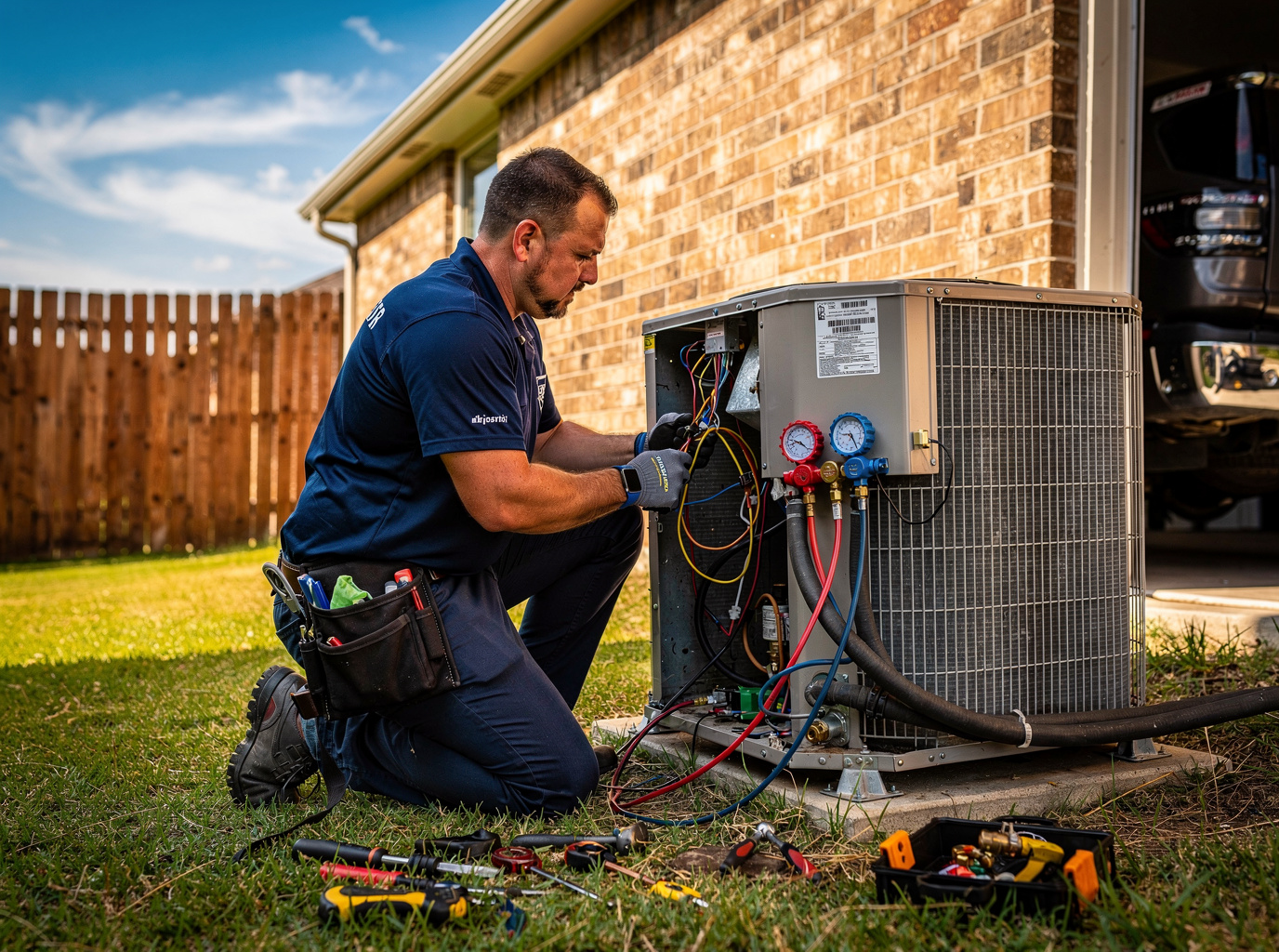
2. When You Need It
AC repair is needed when the system stops cooling, will not start, or shows a fault it cannot safely run through. Some signs call for attention soon and others call for it now. Watch for these:
- No cooling or weak cooling. The house stays warm even when the system runs, or certain rooms never reach the set temperature.
- Warm air from the vents. Air coming out of the supply registers is not cold, even though the outdoor unit appears to be running.
- The system will not start. The thermostat calls for cooling, but nothing happens, or the fan runs without the outdoor unit.
- Short cycling. The system starts and stops repeatedly within a short period instead of running a steady cycle.
- Ice on the lines or coil. Frost on the refrigerant line, the outdoor unit or the indoor coil points to a fault that the system cannot run through safely.
- Unusual noises. Grinding, squealing, banging or a loud hum at the outdoor unit each suggests a different kind of fault.
- Water around the indoor unit. Water pooling near the air handler or a stain on the ceiling below it points to a condensate problem.
- A breaker that trips on start. A breaker that trips as the system starts is a warning of an electrical fault. Resetting it repeatedly does not solve the problem.
Some checks are safe for the homeowner. Confirm the thermostat is set to cool, the set temperature is below the room temperature, and the fan is set to auto or on as intended. Check the air filter. A filter clogged with dust restricts airflow, and restricted airflow can make a healthy system look faulty. Replacing a dirty filter is a reasonable first step. If the system still fails after those checks, stop and call for diagnosis rather than opening panels or handling electrical components.
The line between a control fault and a component fault matters. A thermostat that does not send the call for cooling, or a control board that does not energise the contactor, is a control fault. A compressor that does not start, or a fan motor that seizes, is a component fault. The two need different repairs, and they can produce similar symptoms. A homeowner who replaces a part on symptoms alone may buy the wrong component and still have a system that does not run.
Guessing parts wastes money. A capacitor can look like the cause of a no-start, and a contactor can look worn, yet both may be healthy while the real fault sits upstream. Testing in order finds the actual failure, so the repair targets the cause, not the likeliest-looking part.
3. How the Work Runs
Every visit follows a diagnosis-first order. The technician confirms the controls and power, then airflow, then the refrigeration circuit, and only then decides on a repair. The homeowner hears the findings and authorises the work before any part is changed, and the system is verified as a whole before the job closes.
1) Call and triage
The first conversation records the symptoms, the age and type of the system if known, and what changed and when. A change in the thermostat, a new breaker trip, a recent storm, or a service visit by someone else can each narrow the diagnosis. The triage call decides whether the issue can wait for a scheduled visit or needs attention sooner.
Call American HVAC Pros to arrange the visit. Having the answers to the triage questions ready makes the first visit more productive.
2) Diagnosis on site
The technician works in a set order and records evidence at each stage. Controls and power come first: the thermostat, the control signals, the contactor, the capacitor and the supply voltage. Airflow comes second: the filter, the blower, the coil and the supply and return paths. The refrigeration circuit comes last, because readings from it only mean something once airflow and power are known to be sound.
3) Findings stated plainly
Before any work is authorised, the technician states what failed, why it failed where that can be known, and what repair it needs. A plain explanation lets the homeowner decide with the facts in hand. Findings are described in writing or in clear terms, and the homeowner is asked to authorise the repair before the work starts.
4) Repair
The failed component is repaired or replaced. A failed part often overloads its neighbours. A failed capacitor can stress a motor, and a low-charge condition can damage a compressor that is working hard. Related strain points are checked and documented so the repair does not leave a second failure waiting.
5) Verification
After the repair, the system runs a full cycle. The technician reads temperatures and pressures to confirm the refrigeration circuit is working as designed, checks that the airflow is adequate, and confirms the condensate line drains freely. A repair is complete when the whole system runs correctly, not when a single part starts.
6) The honest fork
Some systems reach a point where repair no longer serves them. That can happen because of the system's age, repeated failures in a short period, or the loss of a major component whose replacement involves a large scope of work. When that point is reached, the replacement conversation is opened and routed to the installation page. It is never forced from the repair visit. The homeowner gets the facts and the time to decide.
4. What's Inside This Service
AC repair faults fall into four groups: electrical and control faults, airflow faults, refrigeration circuit faults, and condensate and drainage faults. Each group produces different symptoms, and each is proven by specific tests before any part is replaced. The sections below cover what each group is, the symptoms it causes, how it is proven, and what drives its cost.
Electrical and control faults
Capacitors, contactors, control boards and thermostats are the most common causes of a system that will not start or that starts and stops. A failed capacitor may show as a humming outdoor fan that will not turn, or a compressor that struggles to start. A contactor may chatter, pit or fail to close. A control board may send no signal at all. A thermostat that fails to call for cooling produces the same silence as a dead outdoor unit, which is why the controls are checked before anything else. Each is proven before replacement by testing voltage, continuity and signal with the meter, because replacing a healthy part leaves the fault in place. Cost depends on the part, its availability, and how much access the controls require.
Airflow faults
The blower, the filter and the evaporator coil control how much air moves across the coil. Restricted airflow mimics refrigeration failure: the coil cannot absorb heat, it gets too cold, and it can freeze. A frozen coil then blocks airflow further. A dirty filter, a closed or blocked return, or a blower running at the wrong speed can each produce the same warm-air complaint that a refrigerant fault does. Symptoms often include a coil that ices over, weak airflow at the registers, and a system that runs for a while and then stops. Technicians measure airflow and inspect the blower and coil condition before condemning the refrigeration circuit. Measured airflow across the coil settles the question. Cost depends on the blower's condition, coil cleanliness and the access needed to reach them.
Refrigeration circuit faults
The compressor, the refrigerant charge and the metering device form the refrigeration circuit. The readings taken from it show whether heat is being moved correctly. Symptoms include warm air at the registers, ice on the refrigerant line, and a compressor that runs for long periods without cooling the house. A low charge almost always has a leak behind it, because refrigerant does not wear out. Charge is never simply topped up without finding and addressing the leak, since topping up hides the fault and lets it damage the compressor. Pressures and temperatures at the service ports, read together with airflow and power results, show which part of the circuit is at fault. Cost depends on the component, the leak's location and the amount of work needed to reach it.
Condensate and drainage faults
The condensate drain carries moisture away from the indoor coil. A blocked drain or a failed float switch shuts the system down as a safety measure, and if the water has nowhere to go, it can overflow and damage ceilings and flooring. Typical signs are water near the air handler, a musty smell from the drain or pan, and a system that stops after running for a period. Algae and debris are the usual causes of a blocked line. The fault is small, but its effects are large. It is proven by checking the drain line, the trap, the pan and the float switch while the system runs. Cost depends on the amount of cleaning, the switch and any water damage that has already occurred.
5. Repair and the Texas Framework
In Texas, air conditioning and refrigeration (ACR) contractors are licensed by the Texas Department of Licensing and Regulation (TDLR) under Texas Occupations Code Chapter 1302. Offering ACR services in Texas requires that licence, and a company must employ an ACR contractor in each permanent location where it operates. Technicians must be registered or certified with TDLR and supervised as the rules require.
The licence comes in two classes. Class A covers units of any size. Class B covers cooling up to 25 tons and heating up to 1.5 million BTU per hour. Because the class sets the size of system a company may work on, the question is worth asking by name. The licence class should match the size of the equipment on the job.
Homeowners have a right to verify these facts. Any company offering AC work in Texas can be checked against the [TDLR licence lookup](https://www.tdlr.texas.gov/LicenseSearch/). Asking the company for its licence details and checking them there is ordinary consumer diligence, and any legitimate contractor will expect the question. The check can be made before any work is authorised. Checking the class before work starts is part of the same diligence.
In Dallas, repair work that crosses into installing, replacing or modifying a system enters the City's mechanical permit framework. The Dallas city page carries the detail. A repair that stays within the existing system may not need that permit, but the line is drawn by the scope of the work, so the question is worth asking before the work starts. A job that starts as a repair and grows into installing, replacing or modifying equipment is covered from the point it crosses that line.
This page does not state the licence status of American HVAC Pros. The framework above is stated so homeowners know what to check, and every licence claim should be verified at the TDLR lookup rather than taken from this page.
6. What AC Repair Costs Depend On
A repair's cost depends on the specific system and fault, not on a standard price. The factors below drive it: the diagnostic scope needed to prove the fault, the access time to the equipment, parts availability, and any knock-on strain on related components. Each is assessed during diagnosis, before authorisation.
- Which component failed. The scope of work differs between a control part such as a capacitor or contactor and a compressor, and so does the labour each repair requires.
- Diagnostic scope. The number of checks needed to prove the fault depends on which group it sits in and how the symptoms point. A fault that is proven first avoids searching again later.
- System age and parts availability. Older equipment may need parts that are harder to source, and that affects both the time and the cost of the repair. Where a part must be ordered, the wait extends the time the job takes to close.
- Access to the equipment. A unit in a tight, awkward or elevated location takes more labour to reach than one in an open yard. Time spent reaching the equipment is part of the scope of work.
- Knock-on damage. A failure that has already strained or damaged related components adds work to the repair, so the total cost reflects everything that needs attention.
- The repair-versus-replace horizon. A repair on an aging system may be weighed against the time the system is expected to keep running, and that judgement sits behind the honest fork described in Section 3.
Cost is never settled by guesswork. The process commitment is that findings come before authorisation. The homeowner sees what failed, why, and what repair it needs before deciding whether to proceed. That sequence is the main protection against paying for work that was not needed.
7. Questions People Ask
How expensive is HVAC work?
The cost of HVAC work is driven by the factors above: which component has failed, how old the system is and whether its parts are still easy to source, how hard the equipment is to reach, whether the fault has damaged related parts, and parts compared with labour. The honest way to understand the cost is to ask for the findings first, see what failed and what it needs, and then decide.
My AC runs but blows warm air. What is checked first?
The diagnosis follows a fixed order. Controls and power come first, so the technician confirms the thermostat is calling for cooling and the electrical components are working. Airflow is checked next, including the filter, the blower and the coil. The refrigeration circuit is read last, because its readings only make sense once power and airflow are sound. A homeowner can safely check the thermostat settings and replace a dirty filter before calling, but should not open electrical panels or handle the refrigerant circuit.
Should a refrigerant leak just be topped up?
No. Refrigerant does not wear out, so a low charge means the system has a leak. Topping up restores the pressure for a while but leaves the leak in place, and the system then runs with the wrong charge, which can damage the compressor. The leak must be located and repaired first. Only then is the charge set to the correct level, and the system is verified afterwards.
When does repair stop making sense?
Repair stops making sense when the cost of keeping the system running approaches the value of the system as a whole. The factors are the system's age, how often it has failed recently, and whether a major component such as the compressor is gone. When those factors point that way, the replacement conversation is opened and routed to the installation page. The decision is the homeowner's, made with the findings in front of them, and it is never forced during a repair visit.