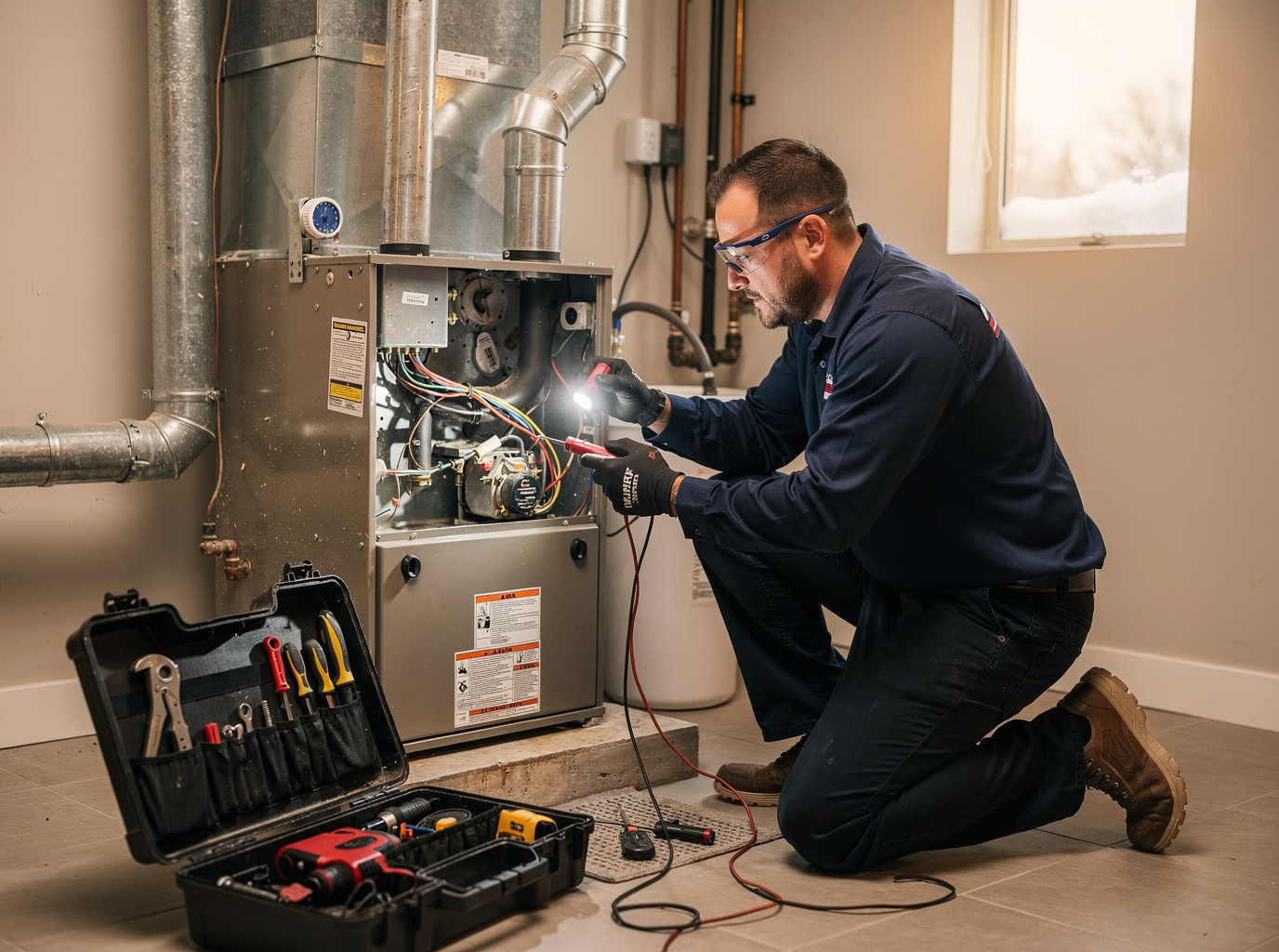
1. What Furnace Services Is
A furnace that was inspected properly, repaired against a named fault, and tested from start to finish is far easier to judge when the next problem appears. Each visit leaves a written record for the next decision.
This page serves homeowners across the United States. The physical business operates from one address in Dallas, 2249 Vagas St, Dallas, TX 75219, and the Dallas context shapes how the furnace is treated. A furnace in this part of Texas runs for fewer hours than the air conditioner, but the hours it does run fall in the coldest weeks of the year. NOAA's 1991–2020 normals for Dallas Love Field show that hard freezes are a normal part of the winter pattern.
That pattern creates a trap. A furnace that sits idle through the mild months hides its wear. Burners, igniters, controls and the blower degrade quietly, and the first serious cold snap asks everything of them at once. The sensible approach is to check the furnace before the cold arrives, not during it.
A furnace is a combustion appliance when it runs on gas, and a high-draw electrical appliance in either form. That is why its services are safety services first. Combustion, venting and safety controls are inspected before performance is discussed, and a performance finding never overrides a safety finding.
General no-heat triage is covered on Heating Repair. A planned new heating system, including options other than a furnace, is covered on Heating Installation. This page covers furnace repair as part of furnace care, and it stays with the furnace itself. The evidence rule runs through every finding here: a conclusion is drawn only from what was measured, recorded and tested during the visit.
Where a fault is not yet known to be a furnace fault, the triage page is the right first stop. Once the fault is confirmed to sit in the furnace, this page sets out what is checked, what the evidence must show, and how the repair-or-replace question is weighed in the open.
Call American HVAC Pros to arrange the furnace visit before the first cold snap, while there is still time to act calmly.
2. When You Need It
Furnace work arrives at four moments: the pre-winter service visit, no heat or short cycling, a repeat-repair pattern, and an absolute finding that ends the repair conversation. Each one carries a question that the evidence can answer, and the evidence rule is simple: a finding is decided by the documented record, not by assumption.
The pre-winter service visit. This is the planned visit, and its timing matters. It should happen before the first cold snap, when the furnace can be tested without pressure and any finding has time to be planned. The evidence that decides it is simple: the furnace has been idle for months, and its combustion path, ignition chain and airflow have not been checked since the last heating season.
No heat or short cycling. When the furnace stops producing heat, or starts and stops repeatedly, the first question is whether the fault is general heating triage or something that needs furnace repair. General triage is covered on the Heating Repair page. On this page, the depth begins with what happens next: whether the fault is in the ignition chain, the safety controls, the airflow, or the venting. The evidence is the fault pattern itself, recorded on the visit, along with the homeowner's account of what the furnace did.
The repeat-repair pattern. When the same furnace needs repair every winter, the failure pattern itself opens the conversation about replacement. The evidence is the record: how many repairs, which components, how close together they came, and whether the faults share a common cause. A pattern of repeated repairs on a unit that is also aging is the point where replacement deserves a serious discussion.
The absolute findings. Some findings end the repair conversation. A cracked heat exchanger and failed safety controls that cannot be restored to proper function are examples. These findings decide the matter on safety grounds, not on the cost of the work. The evidence is a documented inspection that shows the defect and explains why it cannot be safely returned to service.
Call American HVAC Pros to describe what the furnace is doing, whether it is a single fault or a pattern that keeps returning.
3. How the Work Runs
Every furnace visit follows the same six-step sequence, so the homeowner can see what was checked and why. The order is fixed: history, combustion and venting, electrical controls, airflow, written findings, then verification. Safety comes before performance at every step, and no airflow or temperature reading overrides a safety finding.
1) History and inspection
The visit starts with the furnace's history. The technician notes the age of the unit where it can be established, the repair record, and the homeowner's account of sounds, smells and cycling. A burning smell, a rattle, or a furnace that switches on and off in short bursts each points the inspection in a different direction, so these observations are recorded before any testing begins.
2) Combustion and venting check (gas)
On a gas furnace, the flame is inspected first: its colour, steadiness and shape. The flue and venting path are checked for blockage, leaks and correct draft, and the safety controls that respond to unsafe conditions are confirmed. Performance is not discussed until this stage is complete, because a furnace that cannot burn and vent safely has no performance to measure.
3) Electrical and controls
The ignition chain is tested as a sequence: the igniter, the flame sensor, the control board, and the limit and pressure switches. Each part depends on the one before it, so a weak link anywhere can produce a fault that looks like a different component has failed. Testing the chain in order prevents parts from being replaced on a guess.
4) Airflow
The blower, the filter and the ductwork feeding the furnace are checked for airflow. The key measurement is temperature rise: the difference between the air entering the furnace and the air leaving it. Every furnace has a design range for this rise, set by the manufacturer. A reading inside the range suggests the heat exchanger is absorbing heat properly and the airflow is adequate. A reading outside the range points to airflow restriction or a combustion problem that needs to be found.
5) Findings and the fork, in writing
The inspection ends with a written finding and one of three paths. The furnace can be maintained, repaired with the failed component named, or replaced with the reasoning set out. The homeowner decides with the record in hand, and no path is chosen for them. Call American HVAC Pros to arrange a review of the written findings before any decision is made.
6) Verification after any work
After any repair, the furnace is run through a full heating cycle. The temperature rise is measured again, and the safety controls are confirmed live. A repair is not complete until the furnace has run properly, and the verification is written down alongside the original findings.
4. What's Inside This Service
Four components and processes make up the core of furnace work: the heat exchanger, the ignition and gas train, routine maintenance, and the repair-or-replace judgement. Each one has a clear decision point, and each is covered below in the same order.
The heat exchanger
The heat exchanger separates the burning gas and its exhaust from the air that circulates through the home. Its integrity gives the furnace its permission to keep running safely. Years of heating and cooling cycles can crack the metal, and a crack can let combustion products reach the circulating air. Cracks are not always visible from outside the cabinet, so the inspection checks the surfaces the technician can reach, observes flame behaviour and draft for signs of breach, and compares the findings with the unit's age and repair history. What decides the direction is evidence of a breach, not age alone. A confirmed crack condemns the furnace. It is replaced, never patched, because the safety question outweighs any performance argument. Cost is driven by the unit's design and parts availability. The finding should be written with its location and evidence.
Ignition and gas train
The ignition and gas train includes the igniter, the flame sensor, the gas valve and the burners. These parts work as a chain, and the inspection tests that chain in order, link by link. Igniters weaken with heat cycles, flame sensors collect deposits that prevent a clean signal, and burners can clog with dust or debris. The inspection tests each link in order, and it checks the gas valve's operation and the flame's shape. What decides the direction is which link has failed and whether the failure is a wear item or a sign of a deeper problem. Repairing a single igniter or sensor is usually a different decision from repairing a valve or burner assembly. Cost depends on the component, its availability for the unit's generation, and how much access the technician needs.
Furnace maintenance
The annual visit is the furnace's regular check, and its actual content is specific. The combustion check confirms the flame, the venting and the safety controls. Electrical testing covers the ignition chain, the board and the switches. Airflow and temperature rise are measured against the design range, the blower and filter are inspected, and on condensing furnaces the condensate drain is cleared and checked for proper flow. The visit ends with a written record of each measurement, so the next visit can compare against it. What decides the direction is whether the readings are stable, drifting, or outside the design range. A maintained furnace with a clean record is easier to judge in later years. Cost depends on the number of checks needed and whether the drain or filter requires additional work.
The repair-vs-replace judgement
The repair-or-replace decision is weighed in the open, with the factors set out before a conclusion is reached. Safety findings come first: a breach or a failed safety control decides the matter regardless of other factors. Next comes the failure pattern, whether repairs are recurring and whether they share a cause. Parts availability for the unit's generation matters, because a repair that cannot be completed with a suitable part is a different decision. Finally, the system's remaining realistic life is considered, using the unit's age, condition and repair history rather than a lifespan figure. The homeowner receives the factors in writing, so the decision can be checked. Cost of each path depends on the same factors, and the replacement path also involves permitting and installation scope.
Call American HVAC Pros to describe the repair history, so the repair-or-replace factors can be set out in writing.
5. Furnace Work and the Texas Framework
Furnace work in Texas sits inside a licensing framework that the homeowner can verify directly. Air conditioning and refrigeration contractors are licensed by the Texas Department of Licensing and Regulation (TDLR) under Texas Occupations Code Chapter 1302, with rules in 16 TAC Chapter 75. Offering this work in Texas requires the licence, and technicians must be TDLR-registered or certified and supervised. The licence search is at [TDLR licence lookup](https://www.tdlr.texas.gov/LicenseSearch/), and it is the homeowner's right to use it before any work begins. On the lookup, a homeowner can confirm that a licence is current, that the name on it matches the business quoting the work, and that the technicians are registered or certified as the framework requires.
Licence classes are set by the framework's own terms. Class A covers a unit of any size. Class B covers cooling up to 25 tons and heating up to 1.5 million BTU per hour. The framework's own terms set that boundary, so a homeowner can compare the class on a licence against the size of the unit being serviced or installed.
For replacement work, a Mechanical (HVAC) permit is required when installing, replacing or modifying an HVAC system in the City of Dallas, and it is pulled by a registered Air Conditioning Contractor through DallasNow. Full permit detail is on the Dallas page and the installation page. The permit is the City's record of the replacement work, and it is the homeowner's cue to ask whether one has been pulled before replacement starts.
This page does not state a licence number or class for American HVAC Pros. Ask any furnace contractor for its TDLR licence details and check them yourself with the TDLR search before any work is authorised. Call American HVAC Pros to ask how the licence and permit framework applies to the work you are considering.
6. What Furnace Services Cost Depends On
Furnace costs depend on four factors: the component involved, whether the finding is a wear item or a safety item, parts availability for the unit's generation, and the repair-vs-replace horizon. This page gives no prices or figures, and the factors below decide the direction of any cost discussion.
The component involved. A control board, an igniter, a flame sensor, a gas valve and a heat exchanger each carry different labour, parts and access requirements. The component named in the finding is the starting point for any cost discussion.
Wear item or safety item. A worn igniter is a wear item, and its repair is a routine decision. A failed safety control or a breach in the heat exchanger is a safety item, and the decision is governed by safety first, regardless of the repair cost.
Parts availability for the unit's generation. Some furnaces use parts that remain easy to source, while others require older or harder-to-find components. Availability can shift the balance between repair and replacement.
The repair-vs-replace horizon. A finding can open a longer decision. A repair on a unit that is likely to need replacement within a short period changes the value of the repair. This horizon is stated in writing with the findings. Where repair is the right path, the work is covered on Heating Repair; where replacement is the answer, the planned work is covered on Heating Installation.
The written evidence. How a finding is recorded shapes the whole cost discussion. A finding that names the component, shows the measurement or test behind it, and states whether the evidence points to wear or to safety gives the homeowner a basis for the conversation. A finding without that record leaves the cost question open, so the written evidence is the starting point for any decision.
Findings are always written down before any work is authorised, with the component, the evidence and the factors that shape the decision. Call American HVAC Pros to arrange the written findings before any work begins.
7. Questions People Ask
What does a furnace service visit actually include?
A furnace service visit covers the combustion path, the flue and venting, the safety controls, and the electrical chain, including the igniter, flame sensor, control board, and limit and pressure switches. It also measures airflow and temperature rise against the design range, inspects the blower and filter, and on condensing furnaces clears and checks the condensate drain. The visit ends with a written record of each measurement, so the next visit can compare against it and the homeowner can see what was checked.
What is a heat exchanger, and why does its failure end the conversation?
The heat exchanger separates the burning gas and its exhaust from the air circulating through the home. When it cracks, combustion products can reach that air, which is a safety concern. Because the safety question outweighs performance, a confirmed crack condemns the furnace. It is replaced, never patched. The finding should be written with its location and the evidence behind it, so the homeowner can see why the repair path is closed.
My furnace is repaired every winter now. When is replacement the honest answer?
Replacement becomes the honest answer when the safety findings are serious, when the repairs keep recurring with a shared cause, when parts for the unit's generation are hard to obtain, and when the unit's remaining realistic life is short. The factors are weighed in the open and set out in writing. A single repair does not decide the matter. A pattern across several winters, combined with age and a safety finding, is the point at which replacement should be weighed seriously.
Does a furnace need servicing even in a mild Dallas winter?
Yes. A furnace in this part of Texas runs for fewer hours than the air conditioner, but its wear hides during the idle months. When the first serious cold arrives, the furnace is asked to perform at its hardest, so the visit is best timed before the cold snap. NOAA's normals show that hard freezes are a normal part of the Dallas winter pattern. A mild winter is not a reason to skip the check.