2. When You Need It
Duct cleaning is a condition-based service. The useful question is not how many years have passed since the last cleaning but whether the ducts or the home show a reason to clean. The triggers below are the ones that matter.
- Renovation or construction work in the home. After construction, residue inside the ductwork is the most common reason to inspect.
- Visible debris or dust blowing from the registers. If dust, lint or loose particles come out of supply openings, or a film builds up around the vents, debris has reached the room side of the system. Film on the vents that keeps returning is a reason to inspect again rather than assume the job was finished.
- Evidence of vermin or nesting. Droppings, nesting material or other signs of animals in or around the ductwork are reasons to inspect before anything else. Removing that material is part of the cleaning job, but the way animals got in is a separate repair matter.
- A duct history nobody can account for. In a home you have just bought, or one where no one can say when the ducts were last looked at, an inspection gives you a baseline.
- A musty smell at the registers that traces to debris. When the smell is strongest at the registers and the inspection finds dust or debris on the duct walls, cleaning addresses the cause. When the smell comes from humidity or moisture in the home, the cause sits outside the ducts, and the Indoor Air Quality Services page covers that side of the question.
The counter-case matters as much as the triggers. A clean, intact duct system with none of these triggers does not need cleaning on a calendar. This page does not sell a schedule the evidence does not support. A calendar date alone is never the reason to book a visit, and a clean result from an inspection is a valid outcome. If the ducts are sound and nothing in the home points to a debris problem, the honest answer is to leave them alone and keep the system itself maintained. Ongoing care of the equipment is covered on our Air Conditioning Maintenance page.
3. How the Work Runs
Every job follows the same order. The inspection comes first, so the debris case is established before any cleaning is sold, and each later step builds on what the inspection found. Nobody should agree to a scope they have not seen. The findings are reported in writing at the end, so the homeowner keeps a clear record of the outcome.
1. Inspection first
Registers are removed so the technician can view the duct interiors through the openings. The debris case is established at this stage: what is there, where it sits, and how much of each run can actually be seen. If the inspection does not establish a debris problem, the findings will say so. Cleaning is not sold ahead of the evidence, and a home with no debris case is told that plainly.
2. System preparation
The air handler is isolated and protected before work begins, so loosened material cannot reach the equipment in a way that causes damage. Access points are planned so the technician can reach the full length of each run, not only the sections nearest the openings. Planning the access at this stage avoids gaps where debris is left behind.
3. Negative pressure and agitation
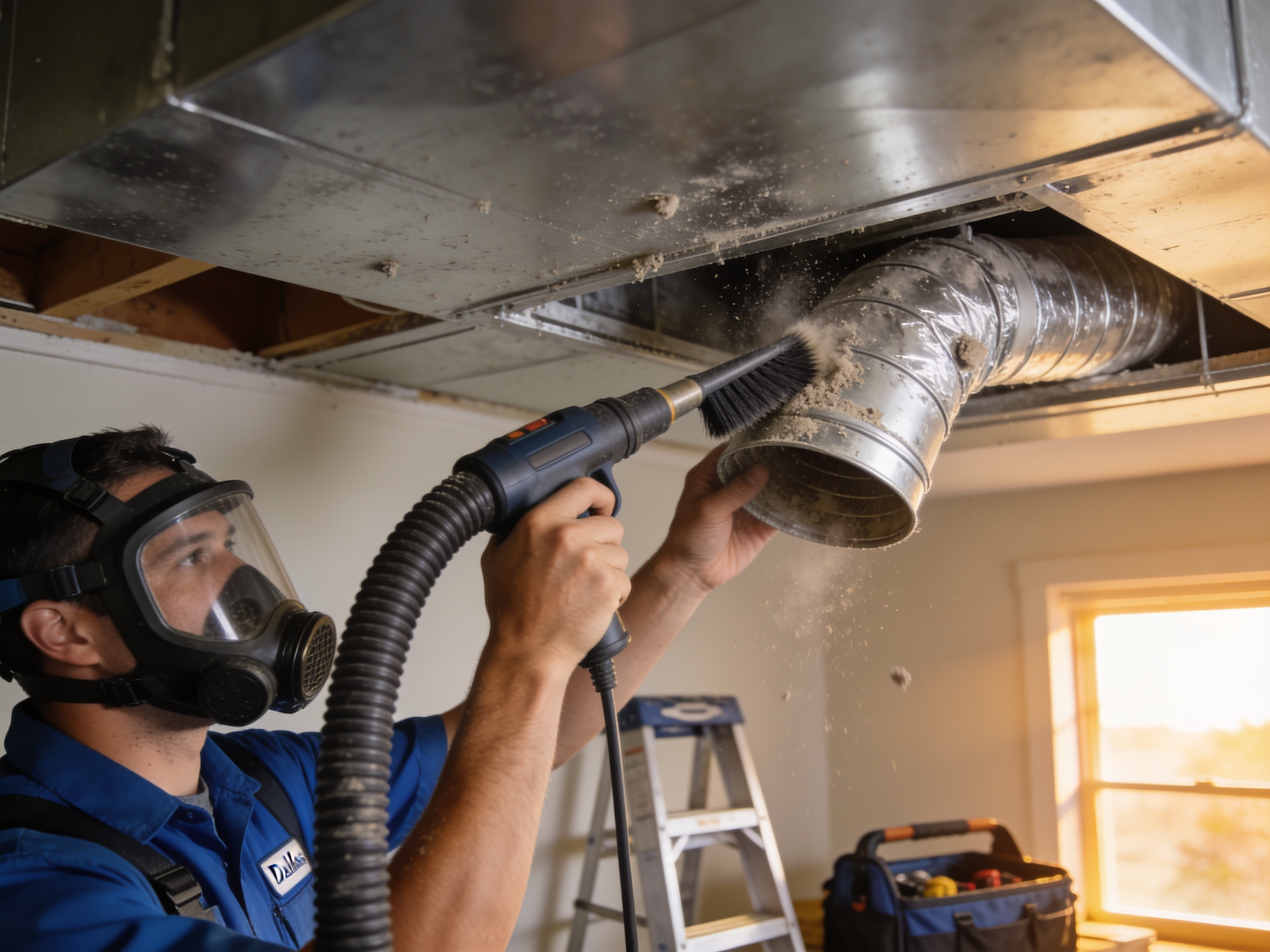
The duct system is placed under extraction vacuum. Brushes or agitators are then moved through the runs to loosen debris that has adhered to the walls. Extraction follows the loosened material out of the system run by run. The work moves in sequence, so each section is cleared before the next is opened, and the technician keeps the vacuum working throughout.
4. Registers, returns and handler surfaces
Registers and return grilles are cleaned as part of the same job. The accessible surfaces of the air handler are addressed in the same visit. These are not add-on extras. They are where room air enters and leaves the system, and debris left there would undo part of the work done in the ducts.
5. Reassembly and run-check
Registers are refitted and the system is run. Airflow at each register is checked to confirm that every opening is delivering air and that nothing was left loose or misfitted during the work. This check confirms the job was completed, not that the ducts are in perfect condition.
6. Findings reported
The findings are reported plainly: what came out of the ducts, what condition the ducts are in, and whether any damage was found. Damage such as leakage, a crushed section or a disconnected run is a separate repair conversation. It is never converted silently into an extra line on the cleaning job.
4. What's Inside This Service
Duct cleaning is made up of several connected parts. Each of the four blocks below explains one part, when it matters, what happens during the work, and what drives its cost.
(a) Negative-pressure extraction
Negative-pressure extraction is the vacuum discipline at the centre of the service. The duct system is placed under a controlled vacuum so that air flows toward the extraction point and carries loosened debris with it. When the vacuum is applied correctly, debris moves out of the ducts through the equipment and does not drift into the rooms through open registers. This matters most while agitation is working, because loosened material is only useful to remove if it is captured. Without that vacuum, loosened debris would simply travel through the system and settle back into the rooms, so the vacuum is what prevents the work from moving dust indoors. What drives the cost of this part is the number of runs that must be sealed off and the length of each run cleared under vacuum.
(b) Agitation methods
Agitation is the mechanical step that loosens debris bonded to the duct walls, and the method follows the duct material, matched to each material before work starts. Sheet metal ducts can take rigid brushes and air whips well, because the surface can be worked without much risk to the duct itself. Flex duct needs lighter brushes and controlled pressure to avoid tearing or puncturing the liner. Ductboard and lined ducts need similar care, because aggressive agitation can damage the lining or board. A technician who uses the same tool on every material is not following the job properly. It is reasonable to ask which method will be used on each duct type and what will happen if a section looks fragile.
(c) The air handler connection
The air handler is the part of duct cleaning that homeowners most often forget to ask about. Its blower compartment and the face of the evaporator coil can collect dust and debris that the ducts do not hold. Where that debris is loose and reachable, it is part of a complete cleaning job. Ask that the handler surfaces be included in the scope in writing. Coil-face debris is not the same as a coil that needs deeper cleaning or repair, and the boundary matters. Routine care of the coil, condensate drain and filters belongs to AC maintenance, covered on our Air Conditioning Maintenance page. Anything that points to a deeper problem with the coil, the drain or the refrigerant side is reported and routed to the right service.
(d) Duct condition findings
Duct cleaning often shows the condition of the duct system more clearly than any other visit. While the technician works the runs, leakage, damage and disconnected sections can come into view. Holes in ducts, separated joints, crushed flex and runs that no longer reach their register are findings, not cleaning outcomes. Where possible, these conditions are photographed so the finding can be seen rather than only described. They are then routed to repair or design, depending on what is needed. A leaking run may be a repair. A system that was never laid out to reach the rooms it serves may be a design question, covered in Section 4(c) of our Air Conditioning Installation page. This block carries the scope honesty of the service. Cleaning removes debris. It does not repair the ducts, and findings are never presented as if it did.
5. Duct Cleaning and the Texas Framework
Duct cleaning sits next to air conditioning and refrigeration work rather than being a part of it. Most of the job happens inside the ductwork, and the homeowner's main question is whether the work was done properly. Where the job touches the HVAC system itself, such as access to the air handler or any change to how the system is modified, the Texas framework for air conditioning and refrigeration contractors becomes the homeowner's verification frame.
Air conditioning and refrigeration contractors in Texas are licensed by the Texas Department of Licensing and Regulation (TDLR) under Texas Occupations Code Chapter 1302, with rules in 16 TAC Chapter 75. Offering air conditioning and refrigeration services in Texas requires that licence. A company must employ a licensed ACR contractor in each permanent location, and technicians must be TDLR-registered or certified and supervised. Licences are issued in classes. Class A covers units of any size. Class B covers cooling up to 25 tons and heating up to 1.5 million BTU per hour. Licence numbers carry endorsements, so the number itself tells you something about the scope of work the licence covers.
Homeowners can check any licence through the [TDLR licence lookup](https://www.tdlr.texas.gov/LicenseSearch/). Use the lookup before you agree to any work that touches the air handler or changes the system.
This page describes the framework only. It does not state that American HVAC Pros holds a TDLR licence, and nothing on this page should be read as a licence statement for this business. No duct-cleaning-specific licence or certification is claimed on this page, and duct cleaning is not presented as carrying any separate credential.
Call American HVAC Pros with questions about the work on your system, and check any licence number a contractor gives you against the public lookup. This page does not state that American HVAC Pros holds a TDLR licence.
6. What Air Duct Cleaning Costs Depend On
Duct cleaning is not sold on a figure fixed in advance. The work depends on the home, and the cost depends on the factors below. Each factor is a reason the job may take more or less time, more or less equipment, or more or less care.
- System count. A home with more than one system has more ductwork to inspect and clean, and each system is a separate piece of work.
- Home size and duct-run length. The total length of the runs, not floor area alone, decides how much surface has to be reached.
- Access. Ducts behind finished walls, in tight attics or under floors take more set-up than ducts with open access points.
- Debris load found. The amount of material in the ducts is only known after inspection. Heavy construction residue takes more time than light dust.
- Duct material and condition. Sheet metal, flex and ductboard each need a different method, and damaged sections need extra care that adds time.
Because these factors can only be judged once the system has been seen, the honest starting point is inspection before cleaning. An inspection establishes the debris case and the condition of the ducts, and it is the basis for deciding whether cleaning is needed at all. Inspections are arranged from our Dallas address at 2249 Vagas St, Dallas, TX 75219. Homeowners in the Dallas area can read more on our Dallas service area page. Call American HVAC Pros to arrange the inspection and talk through which of these factors apply to your home.
7. Questions People Ask
Does duct cleaning improve my health or energy bills?
Duct cleaning removes accumulated dust and debris from inside the ductwork. That is what the service does. Cleaning is judged by what the inspection finds inside the runs, not by any outcome beyond the ducts themselves. For questions about the air itself, see our Indoor Air Quality Services page. The case for cleaning rests on the condition of the ducts: renovation dust, visible debris, vermin evidence and an unknown duct history.
How do I know if my ducts actually need cleaning?
Start with the triggers in Section 2: recent renovation or construction work, visible dust or debris from the registers, evidence of vermin or nesting, a duct history nobody can account for, or a musty smell that traces to debris. If any of these apply, an inspection is the right next step. The inspection looks inside the ducts before any cleaning is sold. If the ducts are clean and intact and none of these triggers applies, the honest answer is that cleaning on a calendar is not needed.
What is the difference between duct cleaning and indoor air quality services?
Duct cleaning deals with the condition of the ducts: the debris collected on the inside of the runs, the registers and the accessible air handler surfaces. Indoor air quality services deal with the air itself, through filtration, humidity control and ventilation. The two intents are separate. A clean duct system does not change the humidity in a home, and a filter change does not remove debris already lying inside the ducts. The air treatment side is covered on our Indoor Air Quality Services page.
Can cleaning damage my ducts?
It can, if the method does not match the material, which is why the method follows the duct type. Sheet metal can take rigid brushes and air whips. Flex duct and lined or ductboard systems need lighter agitation and controlled pressure so the liner or board is not torn or punctured. Damaged sections are noted during inspection and handled with care. If a section looks too fragile to clean safely, the technician reports it as a finding rather than pushing the work through. Ask which method will be used on each duct type before the job starts.